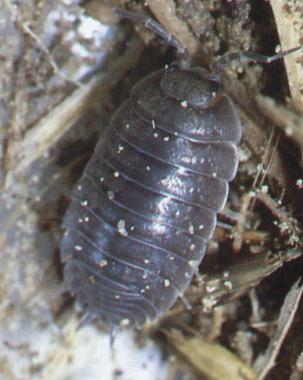
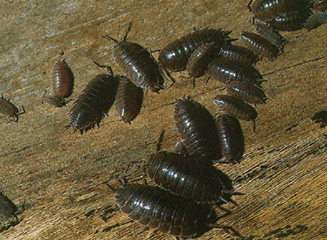
The most predominantly found organism in our ecosystem is the isopod (Porcellio laevis). While we were used to seeing the P. laevis on land, having originally called it the “roley poley,” we were surprised to see an abundance of them not only on land, but also beneath the rocks that were in the river. Both counts in total far exceeded any other counts we had in our ecosystem. One reason for its abundance may be due to the fact that it has few predators in its environment. For each of its three predators, which were the crayfish (Cambarus americanus), the raccoon (Procyon lotor), and the leopard frog (Bufo fowleri), respectively, there was only one organism of each. Below is the generativity of certain systems in the P. laevis.
The integumentary system was generate in the P. laevis. Although it doesn’t have a skin layer, its exoskeleton provides the same functions of support and protection as a layer of skin would. Unlike most integumentary systems, its system limits its size, much in the same way it does with the C. americanus, another crustacean.
The skeletal system was generate in the P. laevis. Like most crustaceans, the P. laevis has an exoskeleton that provides support for the organism. Its pleopods, found in the abdomen, help in the function of swimming and also respiration. It also has a thorax that provides protection that is connected to the P. laevis’s head. It also has to be able to shape its exoskeleton to fit under rocks, because they prefer cooler temperatures, which is why saw more of them on the day when it was 16ºC as compared to the day when it was 25ºC (Buchsbaum).
The muscular system was generate in the P. laevis because it has to support its heavy exoskeleton. Because of the size and complexity of its exoskeleton, it has to allow for its movement, which takes very generate muscles. It must allow for the exoskeleton to shape itself to fit its surroundings, since most of these organisms enjoy the damp, cool temperatures that exist under rocks.
The circulatory system was degenerate in the P. laevis because of its open circulatory system that is used to bathe its organs by pumping its blood straight from the heart out through the aorta rather than sending blood directly to them. While this is sufficient in providing nutrients for the necessary organs, its obvious that because of its behavioral patter of trying to find cooler temperatures in an ecosystem, and by burrowing under rocks on both the land and in the river, it is able to maintain homeostasis.
The respiratory system was in the P. laevis was generate. It performs gas exchange with a common crustacean method. This method involves the intake of oxygen through pleopod gills under the abdominal regions of its body. In order to perform this gas exchange, it has to move its pleopods very quickly as they help the organism swim through the water (similar to the swimmerets in the C. americanus).
The digestive system was in the P. laevis was generate. P. laevis consume both living and dead plant matter as part of its diet, and as such do not need its mandibles to perform much grinding in order to ingest food. Once food has entered its gut, it passes into a cardiac stomach, where further grinding as a part of mechanical digestion takes place. Before food is sent to the maxillary glands for excretion, the final absorption takes place in the cecum, where the only presence of chemical digestion takes place.
The excretory system was in the P. laevis was generate. The P. laevis uses its maxillary glands as its primary waste organ having a very similar function to human kidneys or the C. americanus green gland) which fuses waste out through the anus and can also be released as a gas through the body wall. The maxillary gland turns most of the food that it receives into ammonia, which the most common waste product for both aquatic and land isopods (Buchsbaum). With the isopods that exist on land in our ecosystem, it is much more difficult for them to excrete drier waste, and tends to way down their bodies to a slight extent.
Diagram of a female P. laevis:

Works Consulted:
Barth,
Robert. "Order Isopoda." The Invertebrate World. 1st ed. 1981.
Brusca, Richard. "Isopoda." Isopoda. 6 Aug. 1997. Tree of Life Web Project. 28 May. 2005 http://tolweb.org/tree?group=Isopoda&contgroup=Peracarida#titlefigcaption.
Buchsbaum, Ralph. "Isopods." Animals Without Backbone. 1st ed. 1960.